11 Temmuz 2012 Çarşamba
SAMSUNG Combines Super-Bright Photography With Easy Sharing in the New SMART CAMERA EX2F
[Ljava.lang.String;@234762d1

The ultimate industrial design heritage the Sony LT28h detailed evaluation
[Ljava.lang.String;@5e5654c8
Sony Xperia acro S first version of evaluation: 7/19 listing of press conference
[Ljava.lang.String;@519d3966
10 Temmuz 2012 Salı
Motorola ATRIX™ HD for AT&T is Slimmer, Stronger and Smarter Than Ever Before
.lang.String;@7b73e847
9 Temmuz 2012 Pazartesi
Where Can I Fly?
To contact us Click HERE

If you are planning a vacation and are wondering how far your budget can get you then you should try Flocations.
Using Flocations it is possible to discover which flights are available and to which destinations for a set price. Just use the slider control to enter how much you want to pay for your flight, enter your available dates and select your departure airport from the drop-down menu.
After you have entered an airport and a budget all the available flights in your budget are displayed on the map. If you select a destination shown on the map you can then view the flight details and click on a link to book your seat.
At the moment Flocation only works for a number of South East Asian and Australian airports but new airports and destinations are being added to the application all the time.
If you are planning a vacation and are wondering how far your budget can get you then you should try Flocations.
Using Flocations it is possible to discover which flights are available and to which destinations for a set price. Just use the slider control to enter how much you want to pay for your flight, enter your available dates and select your departure airport from the drop-down menu.
After you have entered an airport and a budget all the available flights in your budget are displayed on the map. If you select a destination shown on the map you can then view the flight details and click on a link to book your seat.
At the moment Flocation only works for a number of South East Asian and Australian airports but new airports and destinations are being added to the application all the time.
Mapping the 2011 Australian Census
To contact us Click HERE

Aus-emaps.com has released a new tool to help visualise data from the Australian Census 2011 Maps.
The application is a Google Maps tool to visualise Population and Housing data from the Australian 2011 Census. The Australian Census 2011 Maps allows users to visualise custom thematic choropleth maps with the census data. The application includes a number of options which allows the user to define which data to display on the map, the values of data ranges, the colours of thematic drapes and the locations of interest.
For help on using the application All Things Spatial has created a handy User Guide to the map.
Aus-emaps.com has released a new tool to help visualise data from the Australian Census 2011 Maps.
The application is a Google Maps tool to visualise Population and Housing data from the Australian 2011 Census. The Australian Census 2011 Maps allows users to visualise custom thematic choropleth maps with the census data. The application includes a number of options which allows the user to define which data to display on the map, the values of data ranges, the colours of thematic drapes and the locations of interest.
For help on using the application All Things Spatial has created a handy User Guide to the map.
Mapping Egyptian Military Influence
To contact us Click HERE

In Egypt Askar Kazeboon (The Military are Liars) is a public-awareness campaign critical of the role of the Supreme Council of the Armed Forces (SCAF) in Egyptian affairs.
The Askar Kazeboon Map is a crowd-sourced Google Map highlighting how retired military officers are being given important roles within the civilian, political and administrative bureaucracy of the country. Each marker on the map names an ex-military officer and indicates which civilian role that they now occupy.
In Egypt Askar Kazeboon (The Military are Liars) is a public-awareness campaign critical of the role of the Supreme Council of the Armed Forces (SCAF) in Egyptian affairs.
The Askar Kazeboon Map is a crowd-sourced Google Map highlighting how retired military officers are being given important roles within the civilian, political and administrative bureaucracy of the country. Each marker on the map names an ex-military officer and indicates which civilian role that they now occupy.
Where to Get Polygon Shapefiles
To contact us Click HERE

MapIt is a new service from MySociety that maps geographical points to administrative areas.
Using the application you can enter a lat,lon of a location and find out what country, region, city, constituency, or state itlies within. When you enter a lat,lon MapIt returns a list of the administrative areas that the location lies within, starting with the country and then drilling down through state, town and neighborhood areas.
MapIt is based on source data from theOpenStreetMap project,so depends on the level of detail that has been added to OpenStreetMap for each location. In my limited testing of MapIt it produces great results for the UK (down to neighborhood level in London) but doesn't produce such fine results for the U.S. (for example a lat,lon in Brooklyn returns New York as the best result).
A really useful function of MapIt for map developers is that it returns the kml for area searches, so MapIt is a great resource if you want shapefiles for administrate areas. To get a shapefile of an area you will need the OpenStreetMap area id for the location. You can then enter a search in the form:
http://global.mapit.mysociety.org/area/[area id].html
For example, here is the result of an area search for Paris. You can view the created KML using Google Maps or grab the polygon data in JSON format.
If you don't know the OpenStreetMap area id number you can just enter a lat,lon for a location and the area id is returned as part of the search results.
MapIt is a new service from MySociety that maps geographical points to administrative areas.
Using the application you can enter a lat,lon of a location and find out what country, region, city, constituency, or state itlies within. When you enter a lat,lon MapIt returns a list of the administrative areas that the location lies within, starting with the country and then drilling down through state, town and neighborhood areas.
MapIt is based on source data from theOpenStreetMap project,so depends on the level of detail that has been added to OpenStreetMap for each location. In my limited testing of MapIt it produces great results for the UK (down to neighborhood level in London) but doesn't produce such fine results for the U.S. (for example a lat,lon in Brooklyn returns New York as the best result).
A really useful function of MapIt for map developers is that it returns the kml for area searches, so MapIt is a great resource if you want shapefiles for administrate areas. To get a shapefile of an area you will need the OpenStreetMap area id for the location. You can then enter a search in the form:
http://global.mapit.mysociety.org/area/[area id].html
For example, here is the result of an area search for Paris. You can view the created KML using Google Maps or grab the polygon data in JSON format.
If you don't know the OpenStreetMap area id number you can just enter a lat,lon for a location and the area id is returned as part of the search results.
The Lovely Google Map
To contact us Click HERE

Lovely is a new apartment finder application that can help you find an apartment or rental home.
The application pulls in data from the most popular listing sites on the web in real-time and the listings are up-dated about once every minute. Lovely uses a the familiar Google Maps interface to allow users to search by location, price and number of bedrooms (you can also choose to filter the results to show only those apartments that allow cats and / or dogs).
The results of an apartment search are displayed on the map with color-coded markers highlighting new and un-viewed listings. You can also set email alerts to be notified when new listings matching your filters become available.
Lovely is a new apartment finder application that can help you find an apartment or rental home.
The application pulls in data from the most popular listing sites on the web in real-time and the listings are up-dated about once every minute. Lovely uses a the familiar Google Maps interface to allow users to search by location, price and number of bedrooms (you can also choose to filter the results to show only those apartments that allow cats and / or dogs).
The results of an apartment search are displayed on the map with color-coded markers highlighting new and un-viewed listings. You can also set email alerts to be notified when new listings matching your filters become available.
8 Temmuz 2012 Pazar
The 1812 War on Google Maps
To contact us Click HERE

In 1812 the United States of America declared war on the United Kingdom thereby beginning the War of 1812.
Brock University has put together an interactive display of geo-referenced historical maps examining some of the invasions of Upper and Lower Canada. The War of 1812 in Maps allows the user to view historical maps of locations of significant battlefield sites and compare them to the current landscape.
The application overlays the historical battlefield maps on top of Google Earth (using the Google Earth plug-in). The user can navigate to the maps by using the links in the map sidebar. It is also possible to adjust the transparency of each map by using a map transparency slide control.
In 1812 the United States of America declared war on the United Kingdom thereby beginning the War of 1812.
Brock University has put together an interactive display of geo-referenced historical maps examining some of the invasions of Upper and Lower Canada. The War of 1812 in Maps allows the user to view historical maps of locations of significant battlefield sites and compare them to the current landscape.
The application overlays the historical battlefield maps on top of Google Earth (using the Google Earth plug-in). The user can navigate to the maps by using the links in the map sidebar. It is also possible to adjust the transparency of each map by using a map transparency slide control.
Transit Tweets on Google Maps
To contact us Click HERE

Transid's RER Tweet Map is a heat map of over 4,000 Tweets in Paris that mention the RER (Paris' rapid transit system).
The map uses the new HeatMap layer in the Google Maps API. This visualisation of the Tweets quickly reveals that (maybe unsurprisingly) that many people mention RER when they are at a station or when on a train.
The map includes a number of options that allow you to adjust the display of the HeatMap layer on the map. The Google Maps API gives developer options to adjust the radius of data points, the opacity of the layer and the colors used. Transid's RER Tweet Map has created buttons to allow the users to change these elements themselves to adjust how the heat map displays on the map.
Transid's RER Tweet Map is a heat map of over 4,000 Tweets in Paris that mention the RER (Paris' rapid transit system).
The map uses the new HeatMap layer in the Google Maps API. This visualisation of the Tweets quickly reveals that (maybe unsurprisingly) that many people mention RER when they are at a station or when on a train.
The map includes a number of options that allow you to adjust the display of the HeatMap layer on the map. The Google Maps API gives developer options to adjust the radius of data points, the opacity of the layer and the colors used. Transid's RER Tweet Map has created buttons to allow the users to change these elements themselves to adjust how the heat map displays on the map.
Own Virtual Property on Google Maps
To contact us Click HERE

Geopieces is a new location and event sharing application.
After you log-in to Geopieces with your Facebook account you can share your location with your friends by adding a marker to the Geopieces Google Map. As well as sharing your location you can use Geopieces to add events to the map, write a blog entry at a location, or leave tips and reviews about venues.
Geopieces users can also add their photos and videos to the map and even add website links to venues on the map.
When you first log-in to Geopieces you are also given 5,000 Geocredits. You can use your Geocredits to own part of the Geopieces map. Users can develop their Geopieces on the map and can even earn more Geocredits if other users visit or add markers to their Geopiece.
Geopieces is a new location and event sharing application.
After you log-in to Geopieces with your Facebook account you can share your location with your friends by adding a marker to the Geopieces Google Map. As well as sharing your location you can use Geopieces to add events to the map, write a blog entry at a location, or leave tips and reviews about venues.
Geopieces users can also add their photos and videos to the map and even add website links to venues on the map.
When you first log-in to Geopieces you are also given 5,000 Geocredits. You can use your Geocredits to own part of the Geopieces map. Users can develop their Geopieces on the map and can even earn more Geocredits if other users visit or add markers to their Geopiece.
Your Mapper Adds Heat Maps
To contact us Click HERE

Your Mapper has added some exciting new features to it's mapped data visualisation application.
Your Mapper provides an easy to use application that allows users to create and visualise data on a Google Map and embed the created map in a website or blog. Your Mapper has used the new HeatMaps layer in the Google Maps API to add a new option to view data as a heat map on a Google Map (for example the screenshot above shows a heat map of greenhouse gas emissions in the USA).
One really cool feature of Your Mapper is that you can visualise data added by other users. So using the links in the map sidebar you can view heat maps for lots of different data sets, from the density of nursing homes to the locations of catholic churches in the USA.
Your Mapper has also added a number of other interesting features such as the option to view a transit layer, a global cloud coverage layer and has also implemented a new muted map style which helps to emphasise the data added to the map.
Your Mapper has added some exciting new features to it's mapped data visualisation application.
Your Mapper provides an easy to use application that allows users to create and visualise data on a Google Map and embed the created map in a website or blog. Your Mapper has used the new HeatMaps layer in the Google Maps API to add a new option to view data as a heat map on a Google Map (for example the screenshot above shows a heat map of greenhouse gas emissions in the USA).
One really cool feature of Your Mapper is that you can visualise data added by other users. So using the links in the map sidebar you can view heat maps for lots of different data sets, from the density of nursing homes to the locations of catholic churches in the USA.
Your Mapper has also added a number of other interesting features such as the option to view a transit layer, a global cloud coverage layer and has also implemented a new muted map style which helps to emphasise the data added to the map.
Map Channels Version 4.08 Update
To contact us Click HERE

Map Channels, the popular Google Maps creation tool, has released a number of new features in its latest update.
Map Channels allows users to create a map with data held in a KML file, a Google Spreadsheet, a GeoRSS feed, tab delimited text or a Google Fusion Table. Map Channels also allows users to add data manually with the 'Edit' feature.
Version 4.8 of Map Channels includes some new features such as the ability to add a transit and weather layer to a created map. Users can also now add links in the header of their maps that show near-by events and near-by hotels.
The latest update to Map Channels also adds a few more customisation options for users and also gives the user the option to locally host a map or to embed it in their own website or blog. A full list of all the new features and improvements in version 4.8 is available on the Map Channels home page.
Map Channels, the popular Google Maps creation tool, has released a number of new features in its latest update.
Map Channels allows users to create a map with data held in a KML file, a Google Spreadsheet, a GeoRSS feed, tab delimited text or a Google Fusion Table. Map Channels also allows users to add data manually with the 'Edit' feature.
Version 4.8 of Map Channels includes some new features such as the ability to add a transit and weather layer to a created map. Users can also now add links in the header of their maps that show near-by events and near-by hotels.
The latest update to Map Channels also adds a few more customisation options for users and also gives the user the option to locally host a map or to embed it in their own website or blog. A full list of all the new features and improvements in version 4.8 is available on the Map Channels home page.
7 Temmuz 2012 Cumartesi
Sony Xperia Tipo hits pre-order in the UK
To contact us Click HERE
We’ve just received word that Sony’s new Xperia Tipo is set to take to store shelves in the coming weeks, with pre-orders kicking off from today. Sony’s new entry-level Xperia is set to attract customers with its sophisticated looks and low price point.
The team at unlocked-mobiles.com are reporting that they now have the Xperia Tipo ready and waiting for pre-orders, with a SIM free price of just £134.98. Despite being an entry level handset, the Tipo does offer the latest Android Ice Cream Sandwich out of the box. Hardware wise you’re treated a spec sheet akin to last year’s mid-range handsets, with an 800MHz single core Snapdragon processor, 512MB of RAM and 2.5GB of inbuilt user storage, expandable via microSD up to 32GB, all of which should be ample for your typical smartphone needs. The screen adorning the Tipo’s front is a 3.2-inch HVGA (320x480) display and the back offers users a 3.2 megapixel camera.
The larger Xperia Miro and the tougher Xperia Go also made it to pre-order earlier this week and with the arrival of the Tipo, Sony have now arranged their complete mid-to-low end device portfolio out. Although the Tipo features in black on unlocked-mobile.com, Expansys are also offering up pre-order of all four colour options which the Tipo will be sold in (black, white, red and blue) the catch being that it’ll cost you £149.99 SIM free. Interestingly the Tipo’s dual-SIM sibling also makes an appearance, although pricing has not yet been confirmed.
For those thinking of picking up an Xperia Tipo, units should arrive from August 20th.
source
We’ve just received word that Sony’s new Xperia Tipo is set to take to store shelves in the coming weeks, with pre-orders kicking off from today. Sony’s new entry-level Xperia is set to attract customers with its sophisticated looks and low price point.
The team at unlocked-mobiles.com are reporting that they now have the Xperia Tipo ready and waiting for pre-orders, with a SIM free price of just £134.98. Despite being an entry level handset, the Tipo does offer the latest Android Ice Cream Sandwich out of the box. Hardware wise you’re treated a spec sheet akin to last year’s mid-range handsets, with an 800MHz single core Snapdragon processor, 512MB of RAM and 2.5GB of inbuilt user storage, expandable via microSD up to 32GB, all of which should be ample for your typical smartphone needs. The screen adorning the Tipo’s front is a 3.2-inch HVGA (320x480) display and the back offers users a 3.2 megapixel camera.
The larger Xperia Miro and the tougher Xperia Go also made it to pre-order earlier this week and with the arrival of the Tipo, Sony have now arranged their complete mid-to-low end device portfolio out. Although the Tipo features in black on unlocked-mobile.com, Expansys are also offering up pre-order of all four colour options which the Tipo will be sold in (black, white, red and blue) the catch being that it’ll cost you £149.99 SIM free. Interestingly the Tipo’s dual-SIM sibling also makes an appearance, although pricing has not yet been confirmed.
For those thinking of picking up an Xperia Tipo, units should arrive from August 20th.
source
Galaxy Note + PS3 Controller Mount
To contact us Click HERE
Reddit Comments:http://www.reddit.com/r/gaming/comments/w6d6y/i_was_askedso_i_made_a_video_of...
http://www.doodle.com/c8k6dusiwe9a4844 -- Poll about the Mount, and purchasing Questions !1
http://imgur.com/a/sRiLs -- Imgur Gallery
http://bit.ly/RdRJ67 --- Reddit Link
http://www.roms4droid.com/ps3-sixaxis.php -- Software, Phone has to be rooted !
After I've been asked often, here is finally a poll where we find out if i can produce it as an handmade article. (Made in Germany, Patent is pending).
The final Version will be made of even thicker metal. It's not conceivable how long it will take until the sleeve opens itself, so we're planing to use cable insulation.
## How much are you willing to pay ?
## Different colours ?
## Made it for other MobilePhones such as Samsung Galaxy s2
http://www.doodle.com/c8k6dusiwe9a4844 -- Poll about the Mount, and purchasing Questions !1
http://imgur.com/a/sRiLs -- Imgur Gallery
http://bit.ly/RdRJ67 --- Reddit Link
http://www.roms4droid.com/ps3-sixaxis.php -- Software, Phone has to be rooted !
After I've been asked often, here is finally a poll where we find out if i can produce it as an handmade article. (Made in Germany, Patent is pending).
The final Version will be made of even thicker metal. It's not conceivable how long it will take until the sleeve opens itself, so we're planing to use cable insulation.
## How much are you willing to pay ?
## Different colours ?
## Made it for other MobilePhones such as Samsung Galaxy s2
HTC profit lags forecasts, faces challenges in third quarter
To contact us Click HERE
Taiwan smartphone maker HTC Corp (2498.TW) saw profit more than halve in the second quarter after European sales disappointed and phones destined for the U.S. market were held up by customs inspections.
The profit fall came on the same day that archrival Samsung Electronics (005930.KS) posted record second-quarter earnings, driven by runaway sales of its Galaxy smartphone [ID:nL3E8I54F4], indicating the size of the challenge facing HTC as it looks to recover market share.
HTC is betting on its new One series of phones to regain market share lost to Samsung and Apple Inc (AAPL.O). HTC, whose sales have grown four-fold since 2010, was battered in the second half last year by the popularity of the iPhone and Galaxy models.
HTC's chief executive, Peter Chou, said in an interview last month that the company will launch other new models in the second half of this year.
But some analysts predict HTC will be upstaged by strong sales of the Galaxy S III and the latest iPhone, which is expected to launch in the fourth quarter.
"In the high-end market, there are Samsung and Apple. In the low-end market, even though HTC wants to gain traction in China, its phones are price uncompetitive," said KGI Securities analyst, Richard Ko.
"HTC's scale and margin are a lot lower compared to Samsung and Apple. It will see much pressure in the short to medium term," Ko said, adding he expected HTC to see limited growth in the second half.
HTC will be further pressured by a sales slowdown faced by the entire industry as the eurozone crisis continues to dampen global consumer sentiment.
"We may not see a traditional high season in the third quarter," said Peter Liao, an analyst at Nomura Securities. "Companies are not seeing strong pull-in and operators are feeling conservative towards giving subsidies."
HTC confirmed a news report on Friday that it has not renewed the contracts of some workers hired during the high season for its production line. The number affected is not more than 1,000, it said.
NUMBERS TELL THE STORY
HTC's unaudited April-June net profit was T$7.4 billion ($247.7 million), the company said, down from T$17.52 billion in the same period a year earlier, but up from T$4.47 billion in the January-March quarter. It did not elaborate.
Earnings had been expected to drop to T$8.25 billion, according to a Thomson Reuters I/B/E/S survey of 21 analysts.
Second-quarter revenue was T$91 billion, improving from T$67.79 billion in the previous quarter.
Last month, HTC cut its second-quarter revenue target by more than 13 percent to T$91 billion and cut its operating margin forecast by 2 percentage points to 9 percent, but kept its gross margin target at 27 percent.
HTC cited the poor economic situation in Europe that was hurting consumer demand, as well as delays to shipments of new phones to the United States due to a requirement for customs inspections after it lost a patent dispute with Apple.
In a separate statement on Friday, HTC said consolidated sales for June were T$30 billion, down 33.4 percent from the same month a year earlier and unchanged from May.
HTC shares closed down 5.15 percent at T$322 before the earnings were released, while the broader market .TWII fell 0.26 percent. The company has a market value of around $11.4 billion.
source
Taiwan smartphone maker HTC Corp (2498.TW) saw profit more than halve in the second quarter after European sales disappointed and phones destined for the U.S. market were held up by customs inspections.
The profit fall came on the same day that archrival Samsung Electronics (005930.KS) posted record second-quarter earnings, driven by runaway sales of its Galaxy smartphone [ID:nL3E8I54F4], indicating the size of the challenge facing HTC as it looks to recover market share.
HTC is betting on its new One series of phones to regain market share lost to Samsung and Apple Inc (AAPL.O). HTC, whose sales have grown four-fold since 2010, was battered in the second half last year by the popularity of the iPhone and Galaxy models.
HTC's chief executive, Peter Chou, said in an interview last month that the company will launch other new models in the second half of this year.
But some analysts predict HTC will be upstaged by strong sales of the Galaxy S III and the latest iPhone, which is expected to launch in the fourth quarter.
"In the high-end market, there are Samsung and Apple. In the low-end market, even though HTC wants to gain traction in China, its phones are price uncompetitive," said KGI Securities analyst, Richard Ko.
"HTC's scale and margin are a lot lower compared to Samsung and Apple. It will see much pressure in the short to medium term," Ko said, adding he expected HTC to see limited growth in the second half.
HTC will be further pressured by a sales slowdown faced by the entire industry as the eurozone crisis continues to dampen global consumer sentiment.
"We may not see a traditional high season in the third quarter," said Peter Liao, an analyst at Nomura Securities. "Companies are not seeing strong pull-in and operators are feeling conservative towards giving subsidies."
HTC confirmed a news report on Friday that it has not renewed the contracts of some workers hired during the high season for its production line. The number affected is not more than 1,000, it said.
NUMBERS TELL THE STORY
HTC's unaudited April-June net profit was T$7.4 billion ($247.7 million), the company said, down from T$17.52 billion in the same period a year earlier, but up from T$4.47 billion in the January-March quarter. It did not elaborate.
Earnings had been expected to drop to T$8.25 billion, according to a Thomson Reuters I/B/E/S survey of 21 analysts.
Second-quarter revenue was T$91 billion, improving from T$67.79 billion in the previous quarter.
Last month, HTC cut its second-quarter revenue target by more than 13 percent to T$91 billion and cut its operating margin forecast by 2 percentage points to 9 percent, but kept its gross margin target at 27 percent.
HTC cited the poor economic situation in Europe that was hurting consumer demand, as well as delays to shipments of new phones to the United States due to a requirement for customs inspections after it lost a patent dispute with Apple.
In a separate statement on Friday, HTC said consolidated sales for June were T$30 billion, down 33.4 percent from the same month a year earlier and unchanged from May.
HTC shares closed down 5.15 percent at T$322 before the earnings were released, while the broader market .TWII fell 0.26 percent. The company has a market value of around $11.4 billion.
source
An external energy source was the cause for the GALAXY SIII that appeared to have heat-related damage
To contact us Click HERE
An external energy source was the cause for the GALAXY SIII that appeared to have heat-related damage
Samsung contracted Fire Investigations UK (FIUK), an independent third-party organization, to determine the exact cause of the damage inflicted on a GALAXY SIII unit, which had allegedly been affected by heat.
The damaged device and additionally provided devices were examined and exposed to a series to tests. The investigation summary states that “The energy source responsible for generating the heat has been determined as external to the device” and “the device was not responsible for the cause of the fire.”
Additionally, the investigation results state, "The only way it was possible to produce damage similar to the damage recorded within the owner's damaged device was to place the devices or component parts within a domestic microwave."
The device user in Ireland has posted on "Boards.ie" admitting that he was responsible for the damage.
 http://www.boards.ie/
Samsung Electronics remains committed to providing our customers with products whose safety and quality are unmatched, as evidenced in the GALAXY SIII. Conclusions of the Investigation Report: * Fire Investigations UK (LLP) provides consultancy services into fires and explosions. The company has been established by gathering a number of individuals from the UK Fire Brigade investigation branch and from the previously closed Forensic Science Service. Fire Investigations UK is also accredited to ISO 9001-2008. Fire Investigations UK has a partnership with BRE Group, which has a 90 year history in building research and fire investigation. The investigation was conducted by Peter Mansi (Managing Partner, Fire Investigations UK) and 3 other specialists. Peter Mansi has 30 years of experience and a Ph.D. in Fire Investigation Methodologies while also being involved, either directly or indirectly, with many of the most high profile fire investigations within the UK and Ireland over the last decade.
An external energy source was the cause for the GALAXY SIII that appeared to have heat-related damage
Samsung contracted Fire Investigations UK (FIUK), an independent third-party organization, to determine the exact cause of the damage inflicted on a GALAXY SIII unit, which had allegedly been affected by heat.
The damaged device and additionally provided devices were examined and exposed to a series to tests. The investigation summary states that “The energy source responsible for generating the heat has been determined as external to the device” and “the device was not responsible for the cause of the fire.”
Additionally, the investigation results state, "The only way it was possible to produce damage similar to the damage recorded within the owner's damaged device was to place the devices or component parts within a domestic microwave."
The device user in Ireland has posted on "Boards.ie" admitting that he was responsible for the damage.
http://www.boards.ie/Samsung Electronics remains committed to providing our customers with products whose safety and quality are unmatched, as evidenced in the GALAXY SIII. Conclusions of the Investigation Report:
* Fire Investigations UK (LLP) provides consultancy services into fires and explosions. The company has been established by gathering a number of individuals from the UK Fire Brigade investigation branch and from the previously closed Forensic Science Service. Fire Investigations UK is also accredited to ISO 9001-2008. Fire Investigations UK has a partnership with BRE Group, which has a 90 year history in building research and fire investigation. The investigation was conducted by Peter Mansi (Managing Partner, Fire Investigations UK) and 3 other specialists. Peter Mansi has 30 years of experience and a Ph.D. in Fire Investigation Methodologies while also being involved, either directly or indirectly, with many of the most high profile fire investigations within the UK and Ireland over the last decade.
Jolla
To contact us Click HERE
Jolla Ltd. is a Finland based smartphone company which continues the great work that Nokia started with MeeGo. The Jolla team is formed by directors and core professionals from Nokia's MeeGo N9 organisation, together with some of the best minds working on MeeGo in the communities.
Nokia created something wonderful - the world's best smartphone product. It deserves to be continued, and we will do that together with all the bright and gifted people contributing to the MeeGo success story.
Together with international investors and partners, Jolla Ltd. will design, develop and sell new MeeGo based smartphones. The Jolla team consists of a substantial number of MeeGo's core engineers and directors, and is aggressively hiring the top MeeGo talent to contribute to the next generation smartphone production.
Jolla Ltd. is a Finland based smartphone company which continues the great work that Nokia started with MeeGo. The Jolla team is formed by directors and core professionals from Nokia's MeeGo N9 organisation, together with some of the best minds working on MeeGo in the communities.
Nokia created something wonderful - the world's best smartphone product. It deserves to be continued, and we will do that together with all the bright and gifted people contributing to the MeeGo success story.
Together with international investors and partners, Jolla Ltd. will design, develop and sell new MeeGo based smartphones. The Jolla team consists of a substantial number of MeeGo's core engineers and directors, and is aggressively hiring the top MeeGo talent to contribute to the next generation smartphone production.
5 Temmuz 2012 Perşembe
Where the roads aren't - and why it matters
To contact us Click HERE
Editor's note: Last week we published a series of blog posts about our activities at Rio+20, the United Nations Conference on Sustainable Development. The post below is by Rebecca Moore, manager of the Google Earth Outreach team.
We were excited to unveil at the Rio+20 Conference the initial fruits of a unique collaboration with a member of the European Parliament and the Society for Conservation Biology: a global, interactive map of the world’s “Roadless Areas.”
The project came about when we were approached by MEP Kriton Arsenis, the European Parliament's Rapporteur on forests. He explained that, while most people using Google Maps want to know which roads will get them from point A to point B, the same information is useful for conservationists who want to know where roads aren’t. In his words:
Start with where the Roads are
We started by taking all the road data (plus rail and navigable waterways) in Google Maps today, and importing that into our Google Earth Engine platform for analysis. For example, here is what the road network in Australia looks like when zoomed out to country-scale:

Then figure out where the roads aren't
Based upon advice from Kriton Arsenis and his project collaborators in the Society for Conservation Biology, we decided to define a “Roadless Area” (for the purposes of this prototype map) as any area of land more than ten kilometers from the nearest road. Using the global-scale spatial-analytic capabilities of Google Earth Engine, we then generated this raster map, such that every pixel in the map is color-coded based on distance from the nearest road. Every pixel colored green is at least 10km from the nearest road, and therefore considered part of a Roadless Area. For example:

Or consider the island of Madagascar, home to some of the most unique species on Earth:

From these maps it becomes more apparent how the simple construction of new roads can fragment and disturb habitats, potentially driving threatened species closer to extinction.
Finally we decided to try running this “Roadless Area” algorithm at global-scale:

Large roadless areas are readily apparent such as the Amazon and Indonesian rainforests, Canadian boreal forest and Sahara desert.
Caveats and Next Steps
The road data used to produce these maps inevitably contains inaccuracies and omissions. The good news is that Google already has a tool, Google Map Maker, that can be used by anyone to submit new or corrected map data, and in fact this tool is already being used in partnership with the United Nations to support global emergency response. We look forward to continued development of this prototype, which can help to turn the abstract concept of “Roadless Areas” into something quite concrete and, we hope, useful to policymakers, scientists and communities around the world. To explore these Roadless Area maps yourself, visit the Google Earth Engine Map Gallery.
Posted by Rebecca Moore, Manager, Google Earth Outreach and Google Earth Engine


Editor's note: Last week we published a series of blog posts about our activities at Rio+20, the United Nations Conference on Sustainable Development. The post below is by Rebecca Moore, manager of the Google Earth Outreach team.
We were excited to unveil at the Rio+20 Conference the initial fruits of a unique collaboration with a member of the European Parliament and the Society for Conservation Biology: a global, interactive map of the world’s “Roadless Areas.”
The project came about when we were approached by MEP Kriton Arsenis, the European Parliament's Rapporteur on forests. He explained that, while most people using Google Maps want to know which roads will get them from point A to point B, the same information is useful for conservationists who want to know where roads aren’t. In his words:
The concept of "roadless areas" is a well-established conservation measure coming from conservation biologists from all around the globe. The idea is that roads in most parts of the world lead to the unmanageable private access to the natural resources of an area, most often leading to ecosystem degradation and without the consent of the local and indigenous communities. Keeping an area roadless means that the specific territory is shielded against such exogenous pressures, thus sustaining its ecosystem services at the maximum possible level. An important tool which will drive environmental, development as well as global climate change policy forward will be the Google development of an interactive satellite map of the world's roadless areas.We were intrigued by Kriton’s idea, so we decided to give it a try.
Start with where the Roads are
We started by taking all the road data (plus rail and navigable waterways) in Google Maps today, and importing that into our Google Earth Engine platform for analysis. For example, here is what the road network in Australia looks like when zoomed out to country-scale:
Then figure out where the roads aren't
Based upon advice from Kriton Arsenis and his project collaborators in the Society for Conservation Biology, we decided to define a “Roadless Area” (for the purposes of this prototype map) as any area of land more than ten kilometers from the nearest road. Using the global-scale spatial-analytic capabilities of Google Earth Engine, we then generated this raster map, such that every pixel in the map is color-coded based on distance from the nearest road. Every pixel colored green is at least 10km from the nearest road, and therefore considered part of a Roadless Area. For example:
Or consider the island of Madagascar, home to some of the most unique species on Earth:
From these maps it becomes more apparent how the simple construction of new roads can fragment and disturb habitats, potentially driving threatened species closer to extinction.
Finally we decided to try running this “Roadless Area” algorithm at global-scale:
Large roadless areas are readily apparent such as the Amazon and Indonesian rainforests, Canadian boreal forest and Sahara desert.
Caveats and Next Steps
The road data used to produce these maps inevitably contains inaccuracies and omissions. The good news is that Google already has a tool, Google Map Maker, that can be used by anyone to submit new or corrected map data, and in fact this tool is already being used in partnership with the United Nations to support global emergency response. We look forward to continued development of this prototype, which can help to turn the abstract concept of “Roadless Areas” into something quite concrete and, we hope, useful to policymakers, scientists and communities around the world. To explore these Roadless Area maps yourself, visit the Google Earth Engine Map Gallery.
Posted by Rebecca Moore, Manager, Google Earth Outreach and Google Earth Engine
Geo in Rio: Cool Tools for a Warming Planet
To contact us Click HERE
Editor's note: Last week we published a series of blog posts on the Google Green Blog about our activities at Rio+20, the United Nations Conference on Sustainable Development. This is our final post in the series - thanks for reading along!
The week we spent at Rio+20 incredibly productive and rewarding. We marveled at the natural beauty of our surroundings, we took hundreds of visitors to our booth for a wild ride on the Liquid Galaxy, and we met with some of the world’s leading experts on sustainable development.
Several of those experts participated in our official Side Event, titled “Tools for Mobile Data Collection: From the Ground to the Cloud” on Monday, June 18th. We’ve been using the “ground to the cloud” phrase a lot these days. It was coined by Vasco van Roosmalen of ECAM, who helped the Surui tribe of the Brazilian Amazon get certification to enter the carbon credit market.
The idea is that data can be collected offline -- using, for instance, Android smartphones and open-source software called Open Data Kit (ODK) -- and then, back in an online environment, uploaded to Google cloud services (like Google Maps Engine) to display in a map. The Surui use this method to collect ground data for their carbon offsets project, and if you download the recently launched Surui Cultural Map you can see exactly where they collected their data. The Surui expect to avoid the emission of 6 million tons of carbon over the 30 years by avoiding the deforestation of 40 thousand hectares of forests and protecting an additional 200,000 hectares.
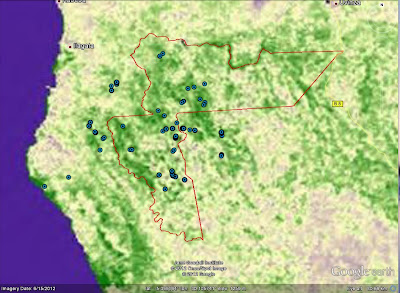
Two other participants at our event, Fundação Amazonas Sustentável (FAS) and The Jane Goodall Institute demonstrated the importance of community participation in keeping trees standing. FAS is using Open Data Kit to monitor and manage the forest reserves in Juma, Rio Madeira Reserve and in Rio Negro in the Brazilian Amazon. Dr. Lilian Pintea, with Timothy Akugizibwe, Sood Ndimuligo and other Jane Goodall Institute staff, trained over 100 Village Forest Monitors in Tanzania and Uganda to take part in protecting their forest. They’ve also mapped chimpanzee distribution alongside biomass models from Dr. Alessandro Baccini of Woods Hole Research Center (see credits in photo caption).
This is very exciting because it has never been done before. Now, stakeholders in Tanzania and elsewhere can substantially cut their hardware, software and data storage and management costs. They can now fully focus fully on comparing the biomass model with what’s actually on the ground, and develop maps and statistics that better meets decision-makers' information needs. The new biomass map of western Tanzania shows the amount of biological material (and carbon) in the region, and could be an important predictor for modeling potential distribution of chimpanzees in the region.
According to partner Aliança da Terra, it is possible for Brazil's farmers to help feed the world, contribute to economic development, and find a balance with our global human and environmental needs. They’ve created a Registry of Socio-Environmental Responsibility for Brazilian producers of soy, cattle, corn and other crops who want to practice their trade in a way that complies with Brazilian law and doesn’t degrade their land for future farming activities. They launched their new website at the side event, featuring maps of the 400+ properties in the Registry as well as their fire brigades to stop the spread of fire in the Amazon. These maps were created with Google Maps Engine, and Aliança da Terra was one of the early grantees of the Google Maps Engine Grants program.
We were joined by other inspiring speakers on the Ground to the Cloud Story, including World Resources Institute, who previewed their Global Forest Watch 2.0, the Governors’ Climate and Forests Task Force & IPAM, and Imazon (who made their own announcement earlier this week). The important work they’re doing brings a quote from Sir Winston Churchill to mind: 


Editor's note: Last week we published a series of blog posts on the Google Green Blog about our activities at Rio+20, the United Nations Conference on Sustainable Development. This is our final post in the series - thanks for reading along!
The week we spent at Rio+20 incredibly productive and rewarding. We marveled at the natural beauty of our surroundings, we took hundreds of visitors to our booth for a wild ride on the Liquid Galaxy, and we met with some of the world’s leading experts on sustainable development.
Several of those experts participated in our official Side Event, titled “Tools for Mobile Data Collection: From the Ground to the Cloud” on Monday, June 18th. We’ve been using the “ground to the cloud” phrase a lot these days. It was coined by Vasco van Roosmalen of ECAM, who helped the Surui tribe of the Brazilian Amazon get certification to enter the carbon credit market.
The idea is that data can be collected offline -- using, for instance, Android smartphones and open-source software called Open Data Kit (ODK) -- and then, back in an online environment, uploaded to Google cloud services (like Google Maps Engine) to display in a map. The Surui use this method to collect ground data for their carbon offsets project, and if you download the recently launched Surui Cultural Map you can see exactly where they collected their data. The Surui expect to avoid the emission of 6 million tons of carbon over the 30 years by avoiding the deforestation of 40 thousand hectares of forests and protecting an additional 200,000 hectares.
Two other participants at our event, Fundação Amazonas Sustentável (FAS) and The Jane Goodall Institute demonstrated the importance of community participation in keeping trees standing. FAS is using Open Data Kit to monitor and manage the forest reserves in Juma, Rio Madeira Reserve and in Rio Negro in the Brazilian Amazon. Dr. Lilian Pintea, with Timothy Akugizibwe, Sood Ndimuligo and other Jane Goodall Institute staff, trained over 100 Village Forest Monitors in Tanzania and Uganda to take part in protecting their forest. They’ve also mapped chimpanzee distribution alongside biomass models from Dr. Alessandro Baccini of Woods Hole Research Center (see credits in photo caption).
This is very exciting because it has never been done before. Now, stakeholders in Tanzania and elsewhere can substantially cut their hardware, software and data storage and management costs. They can now fully focus fully on comparing the biomass model with what’s actually on the ground, and develop maps and statistics that better meets decision-makers' information needs. The new biomass map of western Tanzania shows the amount of biological material (and carbon) in the region, and could be an important predictor for modeling potential distribution of chimpanzees in the region.
 |
 |
| From Rio+20 |
“What is the use of living, if it be not to strive for noble causes and to make this muddled world a better place for those who will live in it after we are gone?”Posted by Tanya Birch, Google Earth Outreach Team
New 45° imagery available for 31 cities
To contact us Click HERE
It’s time for another update of our 45° imagery coverage in Google Maps – this one including 26 cities in the U.S. and 5 international locations.
Albany – the capital of New York state – started as a Dutch trading post almost 400 years ago, which makes it one of the oldest European settlements in the U.S. The city has repeatedly proven to be innovative in its infrastructure by pioneering public water mains, railroads and water routes. Albany is also home to one of the world’s first commercial airports that contributed to its economic rise.
View Larger Map
The New York State Capitol and the adjacent park
Reggio Calabria is located at the tip of the toe of Italy, separated from Sicily by the Strait of Messina, in the middle of the Mediterranean Sea. Its history dates back more than 2,700 years when the Greeks erected a colony here. Despite its age, relatively modern architecture can be found throughout the city due to a devastating earthquake in 1908 that brought many historic buildings to collapse. Below is the Aragonese Castle, one of the few buildings that withstood the quake.
View Larger Map
The Aragonese Castle
Lyon is known as the capital of gastronomy in Eastern France. It's also the hometown of Auguste and Louis Lumière who are known as the earliest filmmakers in history. And during the Renaissance, Lyon was developed as a center of the silk trade with Italy, resulting in Italian architecture being introduced in and around the city.
View Larger Map
Place des Terreaux and Museum of Fine Arts of Lyon
Below is the full list of updated cities:
US:
Albany, NY; Anniston, AL; Aurora, IL; Buffalo, NY; Champaign, IL; Chico, CA; Cleveland - Westlake, OH; Council Bluffs, IA; Eugene, OR; Grand Junction, CO; Greenville - Lyman Lake, SC; Hot Springs, AR; Houston - Katy, TX; Jefferson City, MO; Kentwood, MI; Logan, UT; Longview, TX; Manhattan, KS; Miami Beach, FL; Mount Vernon, WA; North Myrtle Beach - Little River, SC; Peoria, IL; Plainfield Township, MI; Providence, RI; Thousand Oaks, CA; Yakima, WA.
International:
Biel, Switzerland; Luzern, Switzerland; Lyon, France; Reggio Calabria, Italy; St. Gallen, Switzerland.
Have fun exploring the new sites!
Posted by Bernd Steinert, Geo Data Specialist


It’s time for another update of our 45° imagery coverage in Google Maps – this one including 26 cities in the U.S. and 5 international locations.
Albany – the capital of New York state – started as a Dutch trading post almost 400 years ago, which makes it one of the oldest European settlements in the U.S. The city has repeatedly proven to be innovative in its infrastructure by pioneering public water mains, railroads and water routes. Albany is also home to one of the world’s first commercial airports that contributed to its economic rise.
View Larger Map
The New York State Capitol and the adjacent park
Reggio Calabria is located at the tip of the toe of Italy, separated from Sicily by the Strait of Messina, in the middle of the Mediterranean Sea. Its history dates back more than 2,700 years when the Greeks erected a colony here. Despite its age, relatively modern architecture can be found throughout the city due to a devastating earthquake in 1908 that brought many historic buildings to collapse. Below is the Aragonese Castle, one of the few buildings that withstood the quake.
View Larger Map
The Aragonese Castle
Lyon is known as the capital of gastronomy in Eastern France. It's also the hometown of Auguste and Louis Lumière who are known as the earliest filmmakers in history. And during the Renaissance, Lyon was developed as a center of the silk trade with Italy, resulting in Italian architecture being introduced in and around the city.
View Larger Map
Place des Terreaux and Museum of Fine Arts of Lyon
Below is the full list of updated cities:
US:
Albany, NY; Anniston, AL; Aurora, IL; Buffalo, NY; Champaign, IL; Chico, CA; Cleveland - Westlake, OH; Council Bluffs, IA; Eugene, OR; Grand Junction, CO; Greenville - Lyman Lake, SC; Hot Springs, AR; Houston - Katy, TX; Jefferson City, MO; Kentwood, MI; Logan, UT; Longview, TX; Manhattan, KS; Miami Beach, FL; Mount Vernon, WA; North Myrtle Beach - Little River, SC; Peoria, IL; Plainfield Township, MI; Providence, RI; Thousand Oaks, CA; Yakima, WA.
International:
Biel, Switzerland; Luzern, Switzerland; Lyon, France; Reggio Calabria, Italy; St. Gallen, Switzerland.
Have fun exploring the new sites!
Posted by Bernd Steinert, Geo Data Specialist
Go indoors at locations across the United Kingdom
To contact us Click HERE
Given the current British weather, we seem to be spending a lot more of the summer than we’d hoped indoors. The thing about being indoors is that people often get lost - I’m not talking about in your own home, of course, but when you’re out and about, in train stations, museums, department stores and shopping centres.
We’re happy to announce that today Google is launching indoor maps for Android devices in the UK. You’ll no longer need to feel clueless when you’re at the railway station, trying to figure out where to buy a coffee before you rush to catch your train from platform 11; nor will you feel embarrassed about asking for the lingerie section when you’re in the department store - because you’ll have all the answers in the palm of your hand.
Just open Google Maps on your Android mobile phone, zoom in to the location you’re in and the indoor floor plan magically appears. And for buildings where the information is available, we’ll even show you where you are on the map with a familiar blue dot if you’ve enabled the My Location feature. Next, search for the location you’d like to get to (Platform 9¾ at King’s Cross Station or Peter Jones in Sloane Square) and we’ll provide directions to help you get there - even if you’re on a completely different floor.
 More than 40 venues in the UK have worked with us to have their indoor floor plans appear on Google, ranging from train stations to art galleries, department stores to sporting venues. In fact, any building owner can upload their maps for future inclusion in Google Maps.
I know that I’ll definitely be using the indoor maps feature this summer to find my way around London as I start my work as a volunteer this summer. And no doubt I’ll also be using it in between my shifts, perhaps for a spot of retail therapy at Peter Jones or to check out the James Bond exhibition at the Barbican.
So whatever the weather, take time to explore the indoors this summer in the UK.


Given the current British weather, we seem to be spending a lot more of the summer than we’d hoped indoors. The thing about being indoors is that people often get lost - I’m not talking about in your own home, of course, but when you’re out and about, in train stations, museums, department stores and shopping centres.
We’re happy to announce that today Google is launching indoor maps for Android devices in the UK. You’ll no longer need to feel clueless when you’re at the railway station, trying to figure out where to buy a coffee before you rush to catch your train from platform 11; nor will you feel embarrassed about asking for the lingerie section when you’re in the department store - because you’ll have all the answers in the palm of your hand.
Just open Google Maps on your Android mobile phone, zoom in to the location you’re in and the indoor floor plan magically appears. And for buildings where the information is available, we’ll even show you where you are on the map with a familiar blue dot if you’ve enabled the My Location feature. Next, search for the location you’d like to get to (Platform 9¾ at King’s Cross Station or Peter Jones in Sloane Square) and we’ll provide directions to help you get there - even if you’re on a completely different floor.
More than 40 venues in the UK have worked with us to have their indoor floor plans appear on Google, ranging from train stations to art galleries, department stores to sporting venues. In fact, any building owner can upload their maps for future inclusion in Google Maps.I know that I’ll definitely be using the indoor maps feature this summer to find my way around London as I start my work as a volunteer this summer. And no doubt I’ll also be using it in between my shifts, perhaps for a spot of retail therapy at Peter Jones or to check out the James Bond exhibition at the Barbican.
So whatever the weather, take time to explore the indoors this summer in the UK.
Inside Map Makerpedia
To contact us Click HERE
Less than a year ago, we launched the Map Makerpedia to bring together the collective knowledge and expertise of the Map Maker community into a Wiki-style guide. We recently rolled out an update to the site, which includes a more intuitive layout and revised templates.

We’re thrilled to share these updates and a brief overview of the developments we’ve made over the past few months that have made it an invaluable resource for mappers across the globe.
Map Makerpedia is now divided into three broad categories, “Mapping Tutorials,” “Regional Hubs” and “Community Projects.”

The revised Map Makerpedia layout
The “Mapping Tutorials” pages offer mapping lessons and tutorial videos. Nineteen articles, ranging from “How to map a golf course” to “Mapping roundabouts,” and six videos (in languages as diverse as Russian and Kurdish) currently comprise the Mapping Tutorials section.

Some Help articles in Maps 101
The “Community Projects” section sets the stage for organizers of MapUps to share their event experiences while encouraging others to try their hand at organizing community mapping sessions. From chronicling the efforts of mappers in disaster management and the uplifting of slums, to providing a platform for a veteran mapper to showcase his teaching initiatives, Community Projects is a practical handbook on the benefits of mapping.

Community Projects - on the ground
The “Regional Hubs” section provides a one-stop source for all the regional guidelines. The Regional Hubs not only bring together mappers of one country or territory together under one umbrella, but they also enable mappers from one part of the world to help others across the globe.

Examples of Regional Hubs
Finally, any mention of Map Makerpedia is incomplete without a heartfelt thanks to its amazing contributors! From the sandy dunes of Jordan to paddy-filled Vietnam, from chilly North America to the sunny Asian Sub Continent, with the Pearl of Africa adorning, this is one diverse community.
You too can share your knowledge on Map Makerpedia. Get started!


Less than a year ago, we launched the Map Makerpedia to bring together the collective knowledge and expertise of the Map Maker community into a Wiki-style guide. We recently rolled out an update to the site, which includes a more intuitive layout and revised templates.
We’re thrilled to share these updates and a brief overview of the developments we’ve made over the past few months that have made it an invaluable resource for mappers across the globe.
Map Makerpedia is now divided into three broad categories, “Mapping Tutorials,” “Regional Hubs” and “Community Projects.”
The “Mapping Tutorials” pages offer mapping lessons and tutorial videos. Nineteen articles, ranging from “How to map a golf course” to “Mapping roundabouts,” and six videos (in languages as diverse as Russian and Kurdish) currently comprise the Mapping Tutorials section.
The “Community Projects” section sets the stage for organizers of MapUps to share their event experiences while encouraging others to try their hand at organizing community mapping sessions. From chronicling the efforts of mappers in disaster management and the uplifting of slums, to providing a platform for a veteran mapper to showcase his teaching initiatives, Community Projects is a practical handbook on the benefits of mapping.
The “Regional Hubs” section provides a one-stop source for all the regional guidelines. The Regional Hubs not only bring together mappers of one country or territory together under one umbrella, but they also enable mappers from one part of the world to help others across the globe.
Finally, any mention of Map Makerpedia is incomplete without a heartfelt thanks to its amazing contributors! From the sandy dunes of Jordan to paddy-filled Vietnam, from chilly North America to the sunny Asian Sub Continent, with the Pearl of Africa adorning, this is one diverse community.
You too can share your knowledge on Map Makerpedia. Get started!
4 Temmuz 2012 Çarşamba
Huawei Establishes Open Interoperability Testing Labs to Accelerate TD-LTE Development
To contact us Click HERE
Huawei, a leading global information and communications technology (ICT) solutions provider, announced it had established open TD-LTE IOT (Interoperability Testing) labs in Xi'an and Shenzhen. The labs were established to cooperate with chipset, device and application partners for the purpose of creating an open and win-win LTE ecosystem while driving end-to-end TD-LTE maturation and commercialization.
With the continuous deployment of new commercial network technologies and a rapidly growing number of TD-LTE users, chipset and device makers are faced with rapid market developments. In April of this year, Huawei and Intel established a joint IOT lab in Beijing to promote the development of the TD-LTE ecosystem. The establishment of open IOT labs is another approach for this.
The open IOT labs will focus on LTE solutions for voice, multi-mode roaming and multi-mode smartphones in collaboration with industry partners to promote the maturity and commercialization of the TD-LTE industry.
The IOT lab in Xi'an is capable of conducting interoperability testing between chipsets and network systems, devices and network systems. It can also perform tests between multiple systems, including GSM/WCDMA/CDMA/TD-SCDMA/LTE TDD/FDD and using mainstream TD-LTE bands (1.9, 2.3, 2.6 and 3.5GHz). The lab's device test environment can support tests on devices from five different manufacturers simultaneously.
The Shenzhen IOT lab focuses end-to-end authentication and verifying network performance with different technologies, applications and solutions. Voice, video, LCS (Location Services) and other end-to-end solutions are tested at the Shenzhen IOT lab.
Huawei is committed to the values of openness and cooperation to promote the development of the global ICT industry. Huawei's IOT labs are built to advance the development of the industry through cooperation between industry partners like device and chipset manufacturers, test equipment companies and other companies in the value chain. Huawei welcomes global industry partners to work in Huawei's IOT lab to accelerate the maturity of end-to-end TD-LTE solutions and promote the healthy development of the whole industry chain.
Huawei, a leading global information and communications technology (ICT) solutions provider, announced it had established open TD-LTE IOT (Interoperability Testing) labs in Xi'an and Shenzhen. The labs were established to cooperate with chipset, device and application partners for the purpose of creating an open and win-win LTE ecosystem while driving end-to-end TD-LTE maturation and commercialization.
With the continuous deployment of new commercial network technologies and a rapidly growing number of TD-LTE users, chipset and device makers are faced with rapid market developments. In April of this year, Huawei and Intel established a joint IOT lab in Beijing to promote the development of the TD-LTE ecosystem. The establishment of open IOT labs is another approach for this.
The open IOT labs will focus on LTE solutions for voice, multi-mode roaming and multi-mode smartphones in collaboration with industry partners to promote the maturity and commercialization of the TD-LTE industry.
The IOT lab in Xi'an is capable of conducting interoperability testing between chipsets and network systems, devices and network systems. It can also perform tests between multiple systems, including GSM/WCDMA/CDMA/TD-SCDMA/LTE TDD/FDD and using mainstream TD-LTE bands (1.9, 2.3, 2.6 and 3.5GHz). The lab's device test environment can support tests on devices from five different manufacturers simultaneously.
The Shenzhen IOT lab focuses end-to-end authentication and verifying network performance with different technologies, applications and solutions. Voice, video, LCS (Location Services) and other end-to-end solutions are tested at the Shenzhen IOT lab.
Huawei is committed to the values of openness and cooperation to promote the development of the global ICT industry. Huawei's IOT labs are built to advance the development of the industry through cooperation between industry partners like device and chipset manufacturers, test equipment companies and other companies in the value chain. Huawei welcomes global industry partners to work in Huawei's IOT lab to accelerate the maturity of end-to-end TD-LTE solutions and promote the healthy development of the whole industry chain.
Huawei Announces Breakthrough on HSUPA as the Single-User Uplink Peak Data Rate Exceeds 20Mb/s
To contact us Click HERE
Huawei, a leading global information and communications technology (ICT) solutions provider, announced that a demonstration it conducted broke the HSUPA (High Speed Uplink Packet Access) record for peak single-user uplink data rates with 20Mb/s using DC (Dual Carrier) and 16QAM (Quadrature Amplitude Modulation) technologies.
The mobile broadband era of is gradually changing the habits of end users in ways that put higher uplink rate demands on wireless networks. Uplink rates, however, are far lower than downlink rates, which leads to the bottlenecking of user experience of data services like video or image uploading. Huawei set to work on an uplink breakthrough to bring a vastly improved experience to mobile users.
The record-setting 20Mb/s uplink achievement for the 16QAM higher-order modulation technology and the DC convergence technology was based on Huawei’s unique UMTS algorithms. This breakthrough data rate can ensure that mobile users can upload and share video clips very quickly, greatly improving user experience. The uplink rate can also help popularize more and more multimedia services to further promote the robust development of the mobile broadband industry.
Huawei, a leading global information and communications technology (ICT) solutions provider, announced that a demonstration it conducted broke the HSUPA (High Speed Uplink Packet Access) record for peak single-user uplink data rates with 20Mb/s using DC (Dual Carrier) and 16QAM (Quadrature Amplitude Modulation) technologies.
The mobile broadband era of is gradually changing the habits of end users in ways that put higher uplink rate demands on wireless networks. Uplink rates, however, are far lower than downlink rates, which leads to the bottlenecking of user experience of data services like video or image uploading. Huawei set to work on an uplink breakthrough to bring a vastly improved experience to mobile users.
The record-setting 20Mb/s uplink achievement for the 16QAM higher-order modulation technology and the DC convergence technology was based on Huawei’s unique UMTS algorithms. This breakthrough data rate can ensure that mobile users can upload and share video clips very quickly, greatly improving user experience. The uplink rate can also help popularize more and more multimedia services to further promote the robust development of the mobile broadband industry.
What’s the value of an app?
To contact us Click HERE
What is actually an app worth – and what triggers someone to develop an app? Are we today focusing too much on the monetisation of apps? Troed SÃ¥ngberg, an engineer and researcher at Sony Mobile’s Technology office, adds his personal reflections on this topic in this blog post. Read on for the full post.
A few months ago, over the holidays, I decided to spend some of my saved vacation days doing something real for a change. Today my workdays in research produce all too many documents, but I’ve always felt that code was the language in which I could best express my thoughts.
So I wrote an app. I needed a week to crank out the first version, launching it on the day before Christmas Eve, and was rewarded with a hundred downloads or so during the first few days until its first update.
Since this exercise was meant to be a fulfilling vacation activity for myself, yet something I would be able to refer back to, I decided from the beginning that I wanted to run it as a proper development project. I had a home for it setup with documentation, detailing expected future functionality, a discussion forum and got it listed at the proper places for such applications. Being a true believer in Openness I also opened up a Github account, pushed the source for each new version and took care to develop features in specific branches. You know, all those bits and pieces that are so easy to forget when you’re the only developer and for all intents and purposes the only customer.
And the downloads came. Hundreds. Thousands. People interacted with me on the forum, I received bug reports, numerous feature requests and I was sent translations for inclusion in future versions. I found a number of different video reviews of the app in several different languages, and I saw others talking about it on online forums using words that humbled me.
So I continued on with the project and developed features I had no real use for myself, but that were apparently very popular with others. I extended my testing environment and upgraded the databases used by the app to better handle the increase in usage. I spent another two weeks to get a proper version 1.0 out, before I left my vacation and got back to work.
At that point in time, I estimated my little project to have somewhere around 30000 users. I had spent the better parts of three weeks working on it, and I had most definitely reached the target I had given myself.
And I had been paid nothing.
Money was simply not why I started the project, and it’s not something that was needed for me to reach my goals. Today it’s at v1.1.6, it has an estimated 100000+ users and I’ve been neglecting it for too long due to prioritising my day job. The new SQLite (Ebean) code is still in a branch that needs more work, and even though I’m lucky not having any bugs that need emergency fixing, it seems I need to await my next vacation to get back on track.
So why am I not trying to become an “app millionaire”? I’m sure many of you reading this have released apps on different mobile app stores, and see at least potential in something like what I’ve just described.
There’s no money in Minecraft server plugins, at least not that I know of. My project is known as Courier, a Minecraft Bukkit player to player in-game item based mail system. I estimate the number of users from the number of downloads, since those downloads are done by server admins and servers have anything from one to thousands of users (I use an average of fifteen for my estimate, hoping it’s at least close).
Now why is it that after my revelation about what my vacation project was about we no longer consider it strange that I had no “app millionaire” expectations? If you had any doubts, that’s actually the point I want to discuss with this post From where have we gotten the expectation that all apps, no matter the complexity and the amount of time having been put into them, should be monetarily awarded? After all, a lot of people do throw together quite complex software (much more complex than mine) in a few days or weeks just as I did – and have vastly different intrinsic and extrinsic motivations for doing so.
In my presentation series I often talk about the gold economy vs the gift economy, and one of the books on the topic I truly recommend is The Generous Man by Tor Nørretranders. I had a personal revelation back when I first read it regarding the often misunderstood concept of free when relating to open source development. While not limited to open source in itself, it turns out that humans seldomly do things for free, but still produce things that might compete on the same marketplace as things done with the expection of monetary return.
I believe this very human behaviour produce some of the differences we observe between different software platforms, mobile as well as non-mobile. Understanding these motivations would then be of great importance when deciding on business models, both for those who develop software for a platform as well as for those creating platforms and seeking content.
Monetary reward is but one of all the drivers that make humans create successful things, and is not the only way in which they can be valued. Thus, the answer to the question posed in the beginning of this post would be that it’s … twodimensional. What I don’t know, but would like to see discussed, is how we can become better at recognising those dimensions.
/Troed
(Oh, and of course. What I write about are my personal views, not official Sony Mobile strategy).
What is actually an app worth – and what triggers someone to develop an app? Are we today focusing too much on the monetisation of apps? Troed SÃ¥ngberg, an engineer and researcher at Sony Mobile’s Technology office, adds his personal reflections on this topic in this blog post. Read on for the full post.
A few months ago, over the holidays, I decided to spend some of my saved vacation days doing something real for a change. Today my workdays in research produce all too many documents, but I’ve always felt that code was the language in which I could best express my thoughts.
So I wrote an app. I needed a week to crank out the first version, launching it on the day before Christmas Eve, and was rewarded with a hundred downloads or so during the first few days until its first update.
Since this exercise was meant to be a fulfilling vacation activity for myself, yet something I would be able to refer back to, I decided from the beginning that I wanted to run it as a proper development project. I had a home for it setup with documentation, detailing expected future functionality, a discussion forum and got it listed at the proper places for such applications. Being a true believer in Openness I also opened up a Github account, pushed the source for each new version and took care to develop features in specific branches. You know, all those bits and pieces that are so easy to forget when you’re the only developer and for all intents and purposes the only customer.
And the downloads came. Hundreds. Thousands. People interacted with me on the forum, I received bug reports, numerous feature requests and I was sent translations for inclusion in future versions. I found a number of different video reviews of the app in several different languages, and I saw others talking about it on online forums using words that humbled me.
So I continued on with the project and developed features I had no real use for myself, but that were apparently very popular with others. I extended my testing environment and upgraded the databases used by the app to better handle the increase in usage. I spent another two weeks to get a proper version 1.0 out, before I left my vacation and got back to work.
At that point in time, I estimated my little project to have somewhere around 30000 users. I had spent the better parts of three weeks working on it, and I had most definitely reached the target I had given myself.
And I had been paid nothing.
Money was simply not why I started the project, and it’s not something that was needed for me to reach my goals. Today it’s at v1.1.6, it has an estimated 100000+ users and I’ve been neglecting it for too long due to prioritising my day job. The new SQLite (Ebean) code is still in a branch that needs more work, and even though I’m lucky not having any bugs that need emergency fixing, it seems I need to await my next vacation to get back on track.
So why am I not trying to become an “app millionaire”? I’m sure many of you reading this have released apps on different mobile app stores, and see at least potential in something like what I’ve just described.
There’s no money in Minecraft server plugins, at least not that I know of. My project is known as Courier, a Minecraft Bukkit player to player in-game item based mail system. I estimate the number of users from the number of downloads, since those downloads are done by server admins and servers have anything from one to thousands of users (I use an average of fifteen for my estimate, hoping it’s at least close).
Now why is it that after my revelation about what my vacation project was about we no longer consider it strange that I had no “app millionaire” expectations? If you had any doubts, that’s actually the point I want to discuss with this post From where have we gotten the expectation that all apps, no matter the complexity and the amount of time having been put into them, should be monetarily awarded? After all, a lot of people do throw together quite complex software (much more complex than mine) in a few days or weeks just as I did – and have vastly different intrinsic and extrinsic motivations for doing so.
In my presentation series I often talk about the gold economy vs the gift economy, and one of the books on the topic I truly recommend is The Generous Man by Tor Nørretranders. I had a personal revelation back when I first read it regarding the often misunderstood concept of free when relating to open source development. While not limited to open source in itself, it turns out that humans seldomly do things for free, but still produce things that might compete on the same marketplace as things done with the expection of monetary return.
I believe this very human behaviour produce some of the differences we observe between different software platforms, mobile as well as non-mobile. Understanding these motivations would then be of great importance when deciding on business models, both for those who develop software for a platform as well as for those creating platforms and seeking content.
Monetary reward is but one of all the drivers that make humans create successful things, and is not the only way in which they can be valued. Thus, the answer to the question posed in the beginning of this post would be that it’s … twodimensional. What I don’t know, but would like to see discussed, is how we can become better at recognising those dimensions.
/Troed
(Oh, and of course. What I write about are my personal views, not official Sony Mobile strategy).
[Guide]Rooting Xperia S ICS and GB (Locked Bootloaders)
To contact us Click HERE
This tutorial will show you how to root your xperia s
Make Sure You are on gingerbread stock rom
ROOT TOOLKIT 1.0.1 http://www.mediafire.com/?nrq4t17p98wwn8z
(1) Application Settings: [Unknown sources] checked {Allowed}
(2) Application Settings: Development [USB debugging] checked {Allowed}
(3) Application Settings: Development [Stay awake] checked {Allowed}
(4) Settings -> Display settings [Screen timeout] Set to 30 minutes
*If your screen goes off just once then you won’t be able to return to the installation properly. Very important!!
Please think about your battery and try to keep the display brightness to a minimum.
(5) Please use a regular picture for the background. Do not use the default live wallpaper.
(6) Charge the Xperia S’s battery to 80%.
(7) Use the Generic CH (1257-3740) XPERIA S LT26i ROM (6.1.A.0.452).
Can be found here along with the latest FLASTOOL link: http://www.xdafileserver.nl/index.ph...9%2FSTOCK+ROMS
(8) Net framework 3.5 or later
[Installation Process]
(1) Connect device to PC via USB cable and execute step1.bat
(2) Power down the device and flash LT26i ROM (6.1.A.0.452) with Flashtool
Wipe: (Uncheck the following) *See attached picture*
・Wipe data
・Wipe cache
・Wipe apps log
Exclude: (Uncheck all in the exclude section)
・Exclude partition *When available*
Misc: No final verification (Checked)
*Close Flashtool every time after you finish using it.
*If Flashtool is not closed properly then adb will not function correctly.
(3) Power on the device and execute step2.bat.
*During this step your device will not charge even if connected via the USB cable.
*Please be aware that if your device powers off due to low battery there is a chance of the phone bricking.
(4) Power down the device and flash Xperia S Gingerbread or ICS ROM which ever you prefer with Flashtool.
Wipe: (Uncheck the following) *See attached picture*
・Wipe data
・Wipe cache
・Wipe apps log
Exclude: (Uncheck all in the exclude section)
・Exclude partition *When available*
Misc: No final verification (Checked)
*Close Flashtool every time after you finish using it.
*If Flashtool is not closed properly then adb will not function correctly.
After your boot set up is complete you will see ‘acore process closed (stopped working) unexpectedly’, just close the dialog box and wait for the phone to settle.
Connect the device to the PC via USB and execute step3.bat.
If the process doesn’t execute or connect correctly, stop the batch process and execute again.
Wait for the batch process to complete. (You are waiting for the ADBD to finish)
*Please be careful not to have your screen go off here. You’ll have trouble returning the installation process.
(6) Execute step4.bat (Your phone might reboot after this process)
Continue with the execution of step5.bat.
(7) Power down the device and Xperia s whichever you have GB or ICS ROM with Flashtool.
Wipe: (check the following) *See attached picture*
・Wipe data
・Wipe cache
・Wipe apps log
Exclude: (check all in the exclude section)
Misc: No final verification (Checked)
*Close Flashtool every time after you finish using it.
*If Flashtool is not closed properly then adb will not function correctly.
(8) Power on the device and install SuperUser from the Google PLAY store. Titanium Backup is optional.
Complete
[Credits]
Ver1.0.1 docomo SO-03D both acro HD models and xperia s succefully compatible
Referenced material from:
TwitterID: lizan -san
TwitterID: piccoro28 -san
TwitterID: yuucyarisu -san
Thank you.
Japanese version originally posted by�ー� (HUHKA)
This guide is originally intended for the Japanese Sony Xperia acro HD docomo SO-3D and KDDI IS12S models.
*Please use precaution*
__________________________________________________ _____________________________________________
THANKS:
puriketsuangel TwitterID: yuucyarisu
huhka_com http://arrowstab-f01d.blogspot.fr/
Kreeckmann For being the first to point out how to remove .txt errors
tommyrumbler For workaround due to .txt errors
http://forum.xda-developers.com/showthread.php?t=1742992
This tutorial will show you how to root your xperia s
Make Sure You are on gingerbread stock rom
ROOT TOOLKIT 1.0.1 http://www.mediafire.com/?nrq4t17p98wwn8z
(1) Application Settings: [Unknown sources] checked {Allowed}
(2) Application Settings: Development [USB debugging] checked {Allowed}
(3) Application Settings: Development [Stay awake] checked {Allowed}
(4) Settings -> Display settings [Screen timeout] Set to 30 minutes
*If your screen goes off just once then you won’t be able to return to the installation properly. Very important!!
Please think about your battery and try to keep the display brightness to a minimum.
(5) Please use a regular picture for the background. Do not use the default live wallpaper.
(6) Charge the Xperia S’s battery to 80%.
(7) Use the Generic CH (1257-3740) XPERIA S LT26i ROM (6.1.A.0.452).
Can be found here along with the latest FLASTOOL link: http://www.xdafileserver.nl/index.ph...9%2FSTOCK+ROMS
(8) Net framework 3.5 or later
[Installation Process]
(1) Connect device to PC via USB cable and execute step1.bat
(2) Power down the device and flash LT26i ROM (6.1.A.0.452) with Flashtool
Wipe: (Uncheck the following) *See attached picture*
・Wipe data
・Wipe cache
・Wipe apps log
Exclude: (Uncheck all in the exclude section)
・Exclude partition *When available*
Misc: No final verification (Checked)
*Close Flashtool every time after you finish using it.
*If Flashtool is not closed properly then adb will not function correctly.
(3) Power on the device and execute step2.bat.
*During this step your device will not charge even if connected via the USB cable.
*Please be aware that if your device powers off due to low battery there is a chance of the phone bricking.
(4) Power down the device and flash Xperia S Gingerbread or ICS ROM which ever you prefer with Flashtool.
Wipe: (Uncheck the following) *See attached picture*
・Wipe data
・Wipe cache
・Wipe apps log
Exclude: (Uncheck all in the exclude section)
・Exclude partition *When available*
Misc: No final verification (Checked)
*Close Flashtool every time after you finish using it.
*If Flashtool is not closed properly then adb will not function correctly.
After your boot set up is complete you will see ‘acore process closed (stopped working) unexpectedly’, just close the dialog box and wait for the phone to settle.
Connect the device to the PC via USB and execute step3.bat.
If the process doesn’t execute or connect correctly, stop the batch process and execute again.
Wait for the batch process to complete. (You are waiting for the ADBD to finish)
*Please be careful not to have your screen go off here. You’ll have trouble returning the installation process.
(6) Execute step4.bat (Your phone might reboot after this process)
Continue with the execution of step5.bat.
(7) Power down the device and Xperia s whichever you have GB or ICS ROM with Flashtool.
Wipe: (check the following) *See attached picture*
・Wipe data
・Wipe cache
・Wipe apps log
Exclude: (check all in the exclude section)
Misc: No final verification (Checked)
*Close Flashtool every time after you finish using it.
*If Flashtool is not closed properly then adb will not function correctly.
(8) Power on the device and install SuperUser from the Google PLAY store. Titanium Backup is optional.
Complete
[Credits]
Ver1.0.1 docomo SO-03D both acro HD models and xperia s succefully compatible
Referenced material from:
TwitterID: lizan -san
TwitterID: piccoro28 -san
TwitterID: yuucyarisu -san
Thank you.
Japanese version originally posted by�ー� (HUHKA)
This guide is originally intended for the Japanese Sony Xperia acro HD docomo SO-3D and KDDI IS12S models.
*Please use precaution*
__________________________________________________ _____________________________________________
THANKS:
puriketsuangel TwitterID: yuucyarisu
huhka_com http://arrowstab-f01d.blogspot.fr/
Kreeckmann For being the first to point out how to remove .txt errors
tommyrumbler For workaround due to .txt errors
http://forum.xda-developers.com/showthread.php?t=1742992
Qualcomm signs UMC, Samsung for 28-nm chips, says report
To contact us Click HERE
Mobile processor supplier Qualcomm Inc. has signed up foundry United Microelectronics Corp. and Samsung Electronics Co. Ltd. as suppliers of 28-nm chips, according to a Taiwan Economic News report.
The move will help Qualcomm (San Diego, Calif.) cope with tight supply situation at Taiwan Semiconductor Manufacturing Co. Ltd. (Hsinchu, Taiwan), Qualcomm's main foundry.
UMC (Hsinchu, Taiwan) is expected to start supplying Snapdragon S4 processors and 3G/4G baseband chips made using 28-nm process in the fourth quarter of 2012, the report said.
UMC will supply between 3,000 and 5,000 wafers per month, between 20 33 percent of the monthly volume supplied by TSMC, the report said. The chips have already been taped out in a UMC 28-nm CMOS process and passed verification.
No detail was provided about the supply deal with Samsung.
Last week UMC announced that it has licensed 20-nm CMOS process including FinFETs from IBM Corp. And this capability will enhance UMC's manufacturing process roadmap potentially making it more attractive to established and potential customers.
Also last week Paul Jacobs, CEO of Qualcomm Inc., reportedly said he has not ruled out owning a wafer fab or putting large amounts of cash down to ensure the firm's supply of semiconductor chips. That was according to a Bloomberg report.
Jacobs also reportedly said that he expected Qualcomm would be meeting customers' volume requirements by the end of 2012, although it is not clear whether he was already factoring in additional foundry deals.
source
Mobile processor supplier Qualcomm Inc. has signed up foundry United Microelectronics Corp. and Samsung Electronics Co. Ltd. as suppliers of 28-nm chips, according to a Taiwan Economic News report.
The move will help Qualcomm (San Diego, Calif.) cope with tight supply situation at Taiwan Semiconductor Manufacturing Co. Ltd. (Hsinchu, Taiwan), Qualcomm's main foundry.
UMC (Hsinchu, Taiwan) is expected to start supplying Snapdragon S4 processors and 3G/4G baseband chips made using 28-nm process in the fourth quarter of 2012, the report said.
UMC will supply between 3,000 and 5,000 wafers per month, between 20 33 percent of the monthly volume supplied by TSMC, the report said. The chips have already been taped out in a UMC 28-nm CMOS process and passed verification.
No detail was provided about the supply deal with Samsung.
Last week UMC announced that it has licensed 20-nm CMOS process including FinFETs from IBM Corp. And this capability will enhance UMC's manufacturing process roadmap potentially making it more attractive to established and potential customers.
Also last week Paul Jacobs, CEO of Qualcomm Inc., reportedly said he has not ruled out owning a wafer fab or putting large amounts of cash down to ensure the firm's supply of semiconductor chips. That was according to a Bloomberg report.
Jacobs also reportedly said that he expected Qualcomm would be meeting customers' volume requirements by the end of 2012, although it is not clear whether he was already factoring in additional foundry deals.
source
2 Temmuz 2012 Pazartesi
Google I/O Map Videos
To contact us Click HERE
This year at Google I/O a number of exciting new features were added to the Google Maps API. There were also a number of interesting Google Maps based sessions. Here is a quick round-up of some of the videos of the Google I/O sessions that should be of interest to Maps API developers.
What's new in Google Maps Google Maps?
In this video Brian McClendon, Dylan Lorimer and Thor Mitchell introduce the new features added to the Google Maps API during Google I/O.
The three main new features in the API are the Heatmap Layer, the new Symbols feature and the Transit Layer.
Not Just a Map
In this video Josh Livni and Nabil Naghdy review the wealth of additional value that the Maps API has to offer, and the essential features that developers should be aware of across a number of verticals, including real estate, travel, and retail.
Spatial Data Visualization
In this video Brendan Kenny and Enoch Lau take a voyage through the world of map based data visualization, arming you with the tools you need to most effectively bring your data to life on a map using the Maps API v3.
A Master Class in Map Styling
Scott Shawcroft and Jonah Jones show you how you can customize the look and feel of a Google Map. See the Styling section of the Maps API documentation to tailor your map to your message, to your color scheme, or to help emphasize your data.
What's new in Google Maps Google Maps?
In this video Brian McClendon, Dylan Lorimer and Thor Mitchell introduce the new features added to the Google Maps API during Google I/O.
The three main new features in the API are the Heatmap Layer, the new Symbols feature and the Transit Layer.
Not Just a Map
In this video Josh Livni and Nabil Naghdy review the wealth of additional value that the Maps API has to offer, and the essential features that developers should be aware of across a number of verticals, including real estate, travel, and retail.
Spatial Data Visualization
In this video Brendan Kenny and Enoch Lau take a voyage through the world of map based data visualization, arming you with the tools you need to most effectively bring your data to life on a map using the Maps API v3.
A Master Class in Map Styling
Scott Shawcroft and Jonah Jones show you how you can customize the look and feel of a Google Map. See the Styling section of the Maps API documentation to tailor your map to your message, to your color scheme, or to help emphasize your data.
Go offline with Google Maps for Android
To contact us Click HERE
Having an Internet connection has always been a key requirement for using Google Maps for Android... until now.
A few weeks ago we told you that offline Google Maps for Android was coming. Now, you can download the latest version of the app in Google Play, then select and save a region of a map from more than 150 countries for use offline. Whether travelling internationally, carrying a WiFi-only device, heading underground on the subway or restricting your mobile data usage, you can now save up to six large metro areas (e.g., Greater London, Paris, or New York City and surrounding area) and use Google Maps for Android to find your way.
Let’s say you find yourself traveling to London this summer. Before you head off on your trip, simply find the area that you’ll be visiting. Then select “Make available offline” from the menu and verify the area that you would like to save.
Below the map, you’ll see we estimate the file size for you, so you know how much space it will take on your device. Once you confirm your selection the map will immediately start downloading.
If you have GPS enabled on the device, the blue dot will still work without a data connection so you know where you are, and if your device has a compass you can orient yourself without 3G or WiFi connectivity.
So whether you’re traveling internationally or underground, we hope offline maps will help you get around.
Today we’re also releasing a smoother and faster Compass Mode for Street View within Google Maps for Android. It’s the next best thing to being there, because your device becomes a window into a 360-degree, panoramic view of the outdoor or interior location through Business Photos. To experience the improved qualities of this feature you need a device with Google Maps for Android, Android 3.0 or higher and a gyroscope sensor plus version 1.8.1 of Street View on Google Maps.
To learn more about Google Maps for Android features, start here.
Posted by Jiabei Lei, Software Engineer, Google Maps Mobile


Having an Internet connection has always been a key requirement for using Google Maps for Android... until now.
A few weeks ago we told you that offline Google Maps for Android was coming. Now, you can download the latest version of the app in Google Play, then select and save a region of a map from more than 150 countries for use offline. Whether travelling internationally, carrying a WiFi-only device, heading underground on the subway or restricting your mobile data usage, you can now save up to six large metro areas (e.g., Greater London, Paris, or New York City and surrounding area) and use Google Maps for Android to find your way.
Let’s say you find yourself traveling to London this summer. Before you head off on your trip, simply find the area that you’ll be visiting. Then select “Make available offline” from the menu and verify the area that you would like to save.
Below the map, you’ll see we estimate the file size for you, so you know how much space it will take on your device. Once you confirm your selection the map will immediately start downloading.
 |
| Save an area and go to My Places to see all your offline maps |
So whether you’re traveling internationally or underground, we hope offline maps will help you get around.
Today we’re also releasing a smoother and faster Compass Mode for Street View within Google Maps for Android. It’s the next best thing to being there, because your device becomes a window into a 360-degree, panoramic view of the outdoor or interior location through Business Photos. To experience the improved qualities of this feature you need a device with Google Maps for Android, Android 3.0 or higher and a gyroscope sensor plus version 1.8.1 of Street View on Google Maps.
 | |
|
Posted by Jiabei Lei, Software Engineer, Google Maps Mobile
Kaydol:
Kayıtlar (Atom)